
How to Choose the Perfect Domain Name for Your Website

How to Choose the Perfect Domain Name for Your Website ∇
There are several key principles to keep in mind before you settle on a domain name for your site!
Descriptiveness
Your domain should reflect the content of your website. For example, a great domain for an online sneaker store would be sneakers.com or sneakershop.store. Visitors should be able to tell at a glance what the site is about.
Simplicity
Stick to short, punchy, memorable words. Ideally, your domain name should be easy to spell even when heard over the phone — just like sneakers.com in the example above.
Forward-Thinking
Google recommends thinking ahead when choosing a domain name — pick something that fits your site’s theme even if you expand into new areas down the road. For example, if you sell running shoes today but plan to add wholesale options later, it might be smarter to go with fitnessgear.store right from the start rather than something too narrow.
Also, avoid deep subdomain chains like shoes.brands.mystore.com. These are technically subdomains, not real domains. They’re often free on website builders, but they offer very little value — which is exactly why they’re free.
How to Choose a Domain Zone (TLD)
IDN (Internationalized Domain Names) allow non-Latin characters — for example, domains in Arabic, Chinese, or Cyrillic script. However, they come with notable downsides. Because they don’t conform to the standard 26-letter Latin Unicode character set, these domains can render in browsers as something like «xn--d1acufc.xn--p1ai», which looks untrustworthy and is nearly impossible to share verbally or in print.
You can often identify a site’s country or industry from its top-level domain (TLD).
Here are some of the most commonly used TLDs:
- biz — commercial websites and legal entities;
- com — the go-to for commercial sites and individuals alike;
- net — originally for internet-related companies;
- org — non-commercial sites: charities, foundations, organizations, etc.;
- info — news portals, feeds, and informational resources;
- edu — reserved for accredited educational institutions.
In the early days of the internet, each zone was meant to contain only thematically appropriate sites. In practice, that idea never stuck — today you’ll find entertainment sites under .com and commercial ones under .info.
There’s also a large number of TLDs for niche industries:
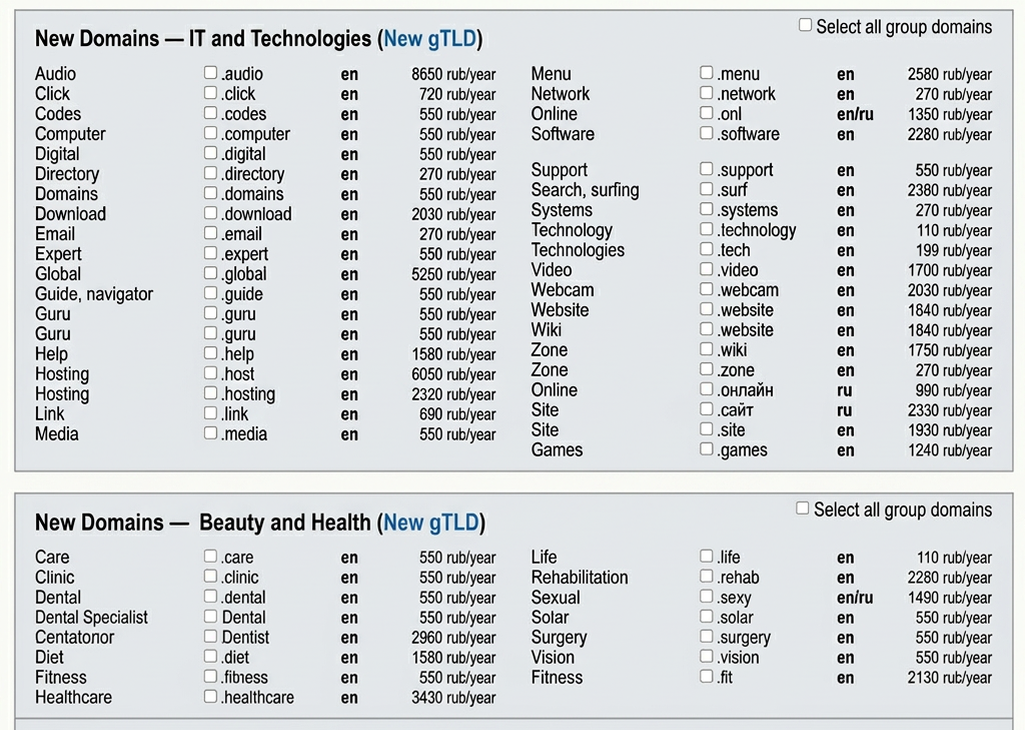
TLDs can be grouped geographically:
- us — United States;
- uk — United Kingdom;
- ca — Canada;
- au — Australia;
- de — Germany;
- fr — France, etc.
Larger regions or cities can also have their own domain zones:
- nyc — New York City;
- london — London.
Common Mistakes When Choosing a Domain Name
A poorly chosen domain can push visitors away and make it harder to build trust. Let’s go through the most frequent mistakes people make when picking a web address.
Meaningless Numbers in Your Domain
You can include a region or area code in your domain, but be aware that this makes it much harder to expand beyond your local market.
Hard-to-Spell Words and Abbreviations
Abbreviations can work — but only if your audience already knows your brand and understands what the acronym stands for. If your abbreviation only makes sense to a small insider group, it’s just a random string of letters to everyone else.
choose a domain name
Hyphens
Users frequently forget to type the hyphen when entering a URL. As a result, they may never actually land on your site.
Repeated Letters at Word Boundaries and Typos
Domains like these are hard to read and create extra confusion when typing them into a browser bar.
Choosing an IDN or Heavily Localized TLD
Non-Latin domain extensions can be awkward for international visitors and may cause issues with corporate email deliverability. You can register such a domain if you want, but it’s best treated as a secondary address rather than your primary one.
Exact-Match Keyword Domains
Using keywords in your domain name is important from an SEO standpoint. They can help. But understand — they only MIGHT help. Their main benefit is more about quick visual recognition and a slight SEO edge from anchor text — not a ranking silver bullet.
choose a domain name
So if you can naturally work a keyword into your domain and it makes the address clearer, go for it. But deliberately engineering your entire domain around a keyword is a bad idea: exact-match domains no longer carry the ranking power they once did, and they can trigger negative associations that users and search engines have built up from years of spammy exact-match domain practices.
Local Domain vs. International Domain
If you want to reach a global audience, go with an international TLD like .com. If you’re targeting a specific country, a country-code TLD (ccTLD) like .us, .uk, or .com.au makes sense. And if your business is hyper-local, regional TLDs can be the right call.
Don’t choose a TLD just because it sounds “prestigious.” If you run a garage door installation company in Austin, Texas, then garagedoors.austin is far more valuable than garagedoors.com. It’s critical that search engines can immediately identify your region and serve you in local results — global visitors are completely irrelevant to your business in that case.
Users often don’t even notice your TLD if they arrived via a link. But when they try to navigate directly — perhaps forgetting or not knowing your exact address — they’ll start guessing.
Most people will default to trying .com before .info. If there’s already a decent site at the .com version of your name, many users will never make it to yours. That’s why, for example, jobs.com will attract far more direct traffic than jobs.info — and people searching for you might end up on a competitor’s site simply because of a more intuitive domain extension.
Note: domain names may contain Latin letters (a–z), digits (0–9), and hyphens — but a hyphen cannot appear at the very beginning or end of the name.
Homonymic Domains
These are top-level domains — most often country-code TLDs — that look or sound like common words or abbreviations in other languages. They typically belong to small, lesser-known nations. Sites registered in these zones are chosen purely for the wordplay, not because of any actual geographic connection.
It’s not uncommon for a private company to purchase registrar rights to a national domain simply because of its catchy sound. That’s exactly what happened with the Pacific island nation of Tuvalu and its .tv domain.
Sometimes a domain name is used not as a standalone word, but as part of one (e.g., del.icio.us, wua.la). A few examples:
- .ag — national domain of Antigua and Barbuda. Used in German-speaking countries (Germany, Austria, Switzerland) by corporations (AG = Aktiengesellschaft).
- .am — national domain of Armenia. Coincides with the abbreviation for amplitude modulation and the time designation “ante meridiem” (see 12-hour clock format).
- .as — national domain of American Samoa. Popular in countries where A/S denotes a corporation.
- .biz — generic TLD for business entities. In Turkish, “biz” means “we” and can be used creatively in brand names.
- .cd — national domain of the Democratic Republic of the Congo. Coincides with the abbreviation for compact disc.
- .ch — national domain of Switzerland. Sometimes used for sites whose names end in “-ch” as part of a word (codesear.ch, swit.ch, etc.).
- .dj — national domain of Djibouti. Coincides with the abbreviation for “disc jockey.”
Shortened Domain Links
Why bother shortening links?
Some platforms have character limits — Twitter/X being the classic example. If you paste a long URL, it gets auto-shortened by Twitter’s own t.co service, which isn’t always ideal. Visually, a long link looks messy and can raise suspicion with readers.
The idea is simple: instead of a long URL like http://yoursite.com/summer-sale-affiliate-campaign-2024/ you get something clean like https://bit.ly/3xRmPQz. Most link shorteners also give you click analytics right in the dashboard. In affiliate marketing especially, links tend to get very long — and there’s a real risk that a potential customer might manually trim the tracking tail off the URL when copying it, costing you the lead attribution.
Downsides of Using Shortened Links Choose a domain name for your website
- Google has deprecated its goo.gl shortener entirely — it’s no longer available for new links, and existing ones are being phased out;
- Bit.ly gets blocked by email providers and various platforms due to widespread spam abuse of the domain;
- TinyURL and ow.ly face similar scrutiny — low-quality sites using these services have damaged their reputation with spam filters, leading to delivery problems in email campaigns or outright blocks on major platforms like Facebook or Reddit.
How to Solve This Problem?
Use a tracking solution, or purchase your own domains and set up a redirect page (a save-page with a redirect, or an HTML page swap pointing to your offer).
Wrapping Up
Don’t skimp on buying proper domains for your ad campaigns. There are virtually unlimited options out there, so there’s no excuse. Links through your own domains pass moderation more easily and give you full control over analytics for your landing pages. That’s far more practical than relying solely on affiliate links. And today, you can register a solid .com domain for around $10 a year, get full DNS panel access, and configure everything exactly how you need it. Just make sure you register with accurate contact details — situations change, and who knows, maybe one day someone will offer you a small fortune for that domain. Good luck out there!
We also recommend reading this article about paid social media advertising.





Discussion
0